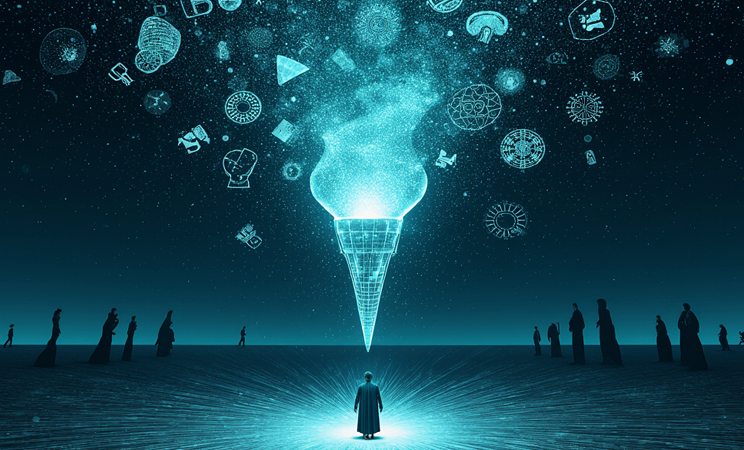
Investigating AI image creation has been quite the endeavour for me this year. What started as curiosity to understand clip and token based models , has quickly become a journey of philosophical reflection. It didn’t take long for me to realize that generative AI, whether for images, text, or sound, is ultimately a sophisticated prediction engine. Feed it enough patterns, and it will “guess” what’s likely to come next.
At times, it feels like nothing short of magic. Combine enough of these generative models, and suddenly it begins to feel otherworldly. But the problem with magic is that we humans tend to fear what we can’t explain. Much like how early medical or herbal knowledge was misunderstood in the Dark Ages, those who practiced it often persecuted as witches or heretics, AI today seems to sit in that same precarious place. A marvel, yes, but also a threat. Will the next phase of history echo the Luddite revolts? Who knows?
So much depends on how we engage with it. What’s clear is this: how we choose to engage with AI matters just as much as what the AI is capable of. Some users treat generative AI as a crutch rather than an empowering tool. In such cases, the interaction becomes passive, less a dialogue, more a surrender. Take the use of AI-assisted tools, via MCP servers. These tools are undoubtedly powerful, but when used by individuals entering the workforce, they can actually stunt growth rather than nurture it. Learning, after all, is rooted in repetition and challenge, not in offloading all your thinking to the very tool that’s supposed to augment your skills. That scares me.
And yet, a puzzling future still lies ahead. Will generative AI eventually learn to repair itself or will we live in a world like Plazir-15 ? I can’t quite fathom it. Either it evolves as proved by the Darwin Gödel Machine Model to maintain internal integrity, or it collapses under its own weight, especially in the face of a global crisis. Let’s be honest about its current limitations though. Ask some of the leading models to solve a basic Math24 puzzle, and as of current you’ll often get guesswork. Ask one to arrange a simple tangram something designed for children, and it falls embarrassingly short. Model deviation, inconsistency, and hallucination are still major challenges. Even though we’re making progress, it’s clear the road ahead is long.
But perhaps that’s exactly the point. Like any tool, AI reflects not only what we feed into it, but how we choose to use it. Will we wield it like a torch in the darkness, or burn ourselves at the stake with it?